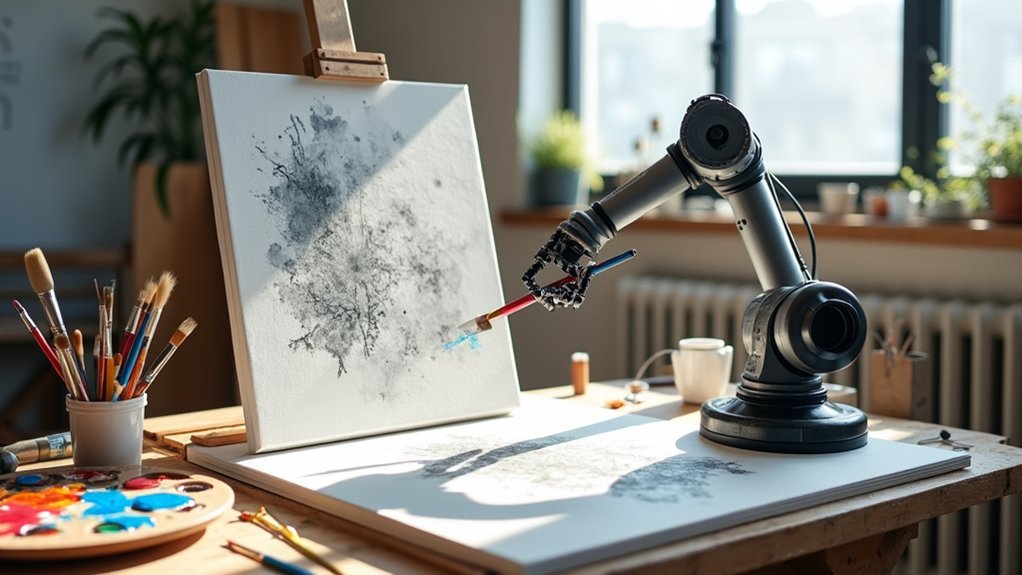

Despite tech companies’ hype, AI isn’t the creative genius they claim. It’s more like a wedding DJ – remixing existing content without true originality. AI lacks human qualities like emotions and daydreaming, which limits its creative potential by over 30%. While great at handling routine tasks and processing data, AI can’t navigate ambiguity or generate genuine insights. The future lies in human-AI collaboration, where each brings unique strengths to the table. There’s more to this story than meets the artificial eye.
Nearly every tech company wants you to believe that AI is bursting with creative genius. The reality? Not even close. While AI can churn out mountains of content faster than a caffeinated copywriter, it’s fundamentally just remixing existing data like a DJ at a wedding – competent but hardly revolutionary.
AI isn’t the creative genius tech companies claim. It’s more like a speedy content remixer – churning out variations on existing themes.
The hard truth is that AI lacks the secret sauce that makes human creativity special. We daydream. We feel. We have those random “aha” moments while taking a shower or walking the dog. AI? It’s stuck following its programming, desperately trying to pattern-match its way to originality. Just like Star Trek’s Data, AI systems require an emotion chip to enhance their creative abilities. Studies show that attempts to make AI more “human-like” in its creativity actually backfire, decreasing its creative scores by over 30%. Ouch. Without engaging in challenging cognitive tasks, AI remains limited to skill atrophy in creative endeavors.
But here’s where it gets interesting. AI isn’t useless – it’s just miscast as a creative genius. Think of it more as a really efficient assistant. It can handle the boring stuff, freeing up humans to do what they do best: actual creative thinking. Research suggests AI tools could give people back about two work weeks per year by handling routine tasks. That’s a lot of time for genuine innovation.
The challenge lies in measuring AI creativity, which is about as straightforward as teaching a cat to fetch. Sure, AI can generate content that looks original at first glance, but dig deeper and you’ll find it’s basically playing a sophisticated game of creative Mad Libs with its training data. No lived experience, no emotional depth, no true understanding – just really good pattern recognition.
Looking ahead, the future of innovation isn’t about AI replacing human creativity – it’s about collaboration. AI excels at processing vast amounts of data and suggesting unexpected connections, while humans bring the genuine insights, emotional resonance, and ability to navigate ambiguity. Together, they’re like peanut butter and jelly – better as a team than solo acts. Just don’t expect AI to write the next great American novel anytime soon.