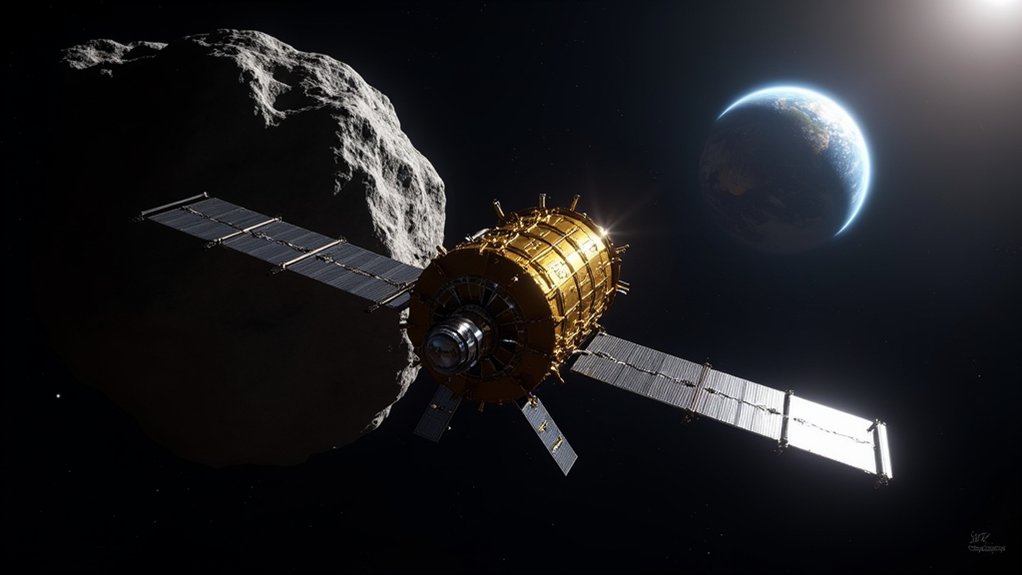

NASA engineers are locked in a high-stakes race against time to prepare OSIRIS-APEX for its rendezvous with asteroid Apophis in 2029. The spacecraft needs four more solar passes before reaching its target, which will swing within 20,000 miles of Earth. One glitch could derail the entire mission. While Apophis poses no impact threat, the 18-month study could revolutionize planetary defense strategies. The pressure’s on – and NASA’s got just one shot at this cosmic dance.
NASA’s race against time just got real. With asteroid Apophis barreling toward its close encounter with Earth in April 2029, scientists are scrambling to guarantee their one shot at studying this space rock doesn’t slip through their fingers. Talk about pressure.
The repurposed OSIRIS-APEX spacecraft, fresh from its asteroid-sampling adventures, needs to thread quite a needle. It has to survive four more passes near the Sun – because apparently space missions weren’t complicated enough already – before reaching its target. The next solar dance happens in May 2025, and everyone’s crossing their fingers the spacecraft doesn’t throw a tantrum.
Engineers are watching OSIRIS-APEX like helicopter parents, running health checks and monitoring fuel levels. One wrong move, one system hiccup, and poof – there goes humanity’s chance to study Apophis up close for decades. No pressure, right?
With engineers hovering over OSIRIS-APEX’s every move, one tiny glitch could derail our only shot at understanding this cosmic visitor.
While Apophis won’t hit Earth in 2029 or 2036 (exhale, everyone), scientists aren’t taking any chances. At a mere 20,000 miles from Earth, this massive space rock will pass closer to us than many communications satellites. The bilobed asteroid, shaped like two connected masses, presents a unique target for observation. This massive space rock is basically a cosmic guinea pig for testing our planetary defense strategies. Because when it comes to asteroid deflection, you really don’t want to wing it.
The mission’s timeline is tighter than a spacecraft’s thermal shield. Once 2027 hits, there’s practically zero wiggle room for course corrections. It’s like trying to parallel park a car blindfolded, except the car is millions of miles away and costs billions of dollars.
The stakes couldn’t be higher. This mission will tell us how asteroids react to Earth’s gravity, improve our impact prediction models, and basically upgrade our entire “please don’t let space rocks hit us” playbook. International space agencies are watching like hawks, ready to share data faster than rumors spread at a high school cafeteria.
If everything goes according to plan, OSIRIS-APEX will reach Apophis just days after its Earth flyby, beginning an 18-month study that could revolutionize planetary defense. If not? Well, let’s just say NASA scientists might need a lot more coffee.